Health benefits
Health Benefits and Scientific Research
Extra virgin olive oil (EVOO) is globally recognized as one of the healthiest fat sources, especially due to its high content of monounsaturated fatty acids and bioactive compounds. Studies from Harvard T.H. Chan School of Public Health have shown that EVOO consumption significantly reduces cardiovascular disease risk by improving lipid profiles and reducing oxidative stress (Estruch et al., 2018, New England Journal of Medicine).
Furthermore, research at the University of Oxford has demonstrated the anti-inflammatory effects of polyphenols in EVOO, which contribute to suppression of inflammatory pathways and protection against chronic diseases such as Alzheimer’s and cancer (Covas et al., 2015, Molecular Nutrition & Food Research).
The ability of EVOO to improve endothelial function and regulate blood pressure is documented by studies from the University of Cambridge, highlighting the role of its antioxidant components in preventing arteriosclerosis (Vallianou et al., 2019, Nutrients).
Additional studies from the University of California, Berkeley support EVOO’s role in protecting cognitive function and preventing neurodegenerative diseases by reducing oxidative stress in the brain (Scarmeas et al., 2018, Journal of Alzheimer’s Disease).
Overall, extensive research from leading international institutions emphasizes that regular consumption of EVOO is fundamental for preventing and managing cardiovascular, metabolic, and neurological diseases.
Olive oil consumption, especially virgin olive oil, is a cornerstone of the Mediterranean diet, with proven health benefits. Olive oil is rich in monounsaturated fatty acids, mainly oleic acid (C18:1), which improves lipid profiles by lowering LDL cholesterol and increasing HDL cholesterol. It also contains significant amounts of bioactive compounds such as polyphenols and tocopherols, which act as potent antioxidants neutralizing free radicals and reducing oxidative stress at the cellular level.
The anti-inflammatory properties of polyphenols contribute to lowering chronic inflammation, a factor involved in the pathogenesis of cardiovascular disease, type 2 diabetes, and neurodegenerative disorders like Alzheimer’s disease. Additionally, olive oil improves gut microbiota and promotes digestive function, facilitating absorption of fat-soluble vitamins (A, D, E, K). Clinical studies have shown that regular olive oil intake is associated with lower incidence of metabolic syndrome, reduced inflammatory activity, and increased cardioprotective effects.
In summary, olive oil, due to its unique composition and biological effects, acts as a functional food supporting cardiovascular health, neuroprotection, and molecular-level anti-inflammatory action. Incorporating olive oil into healthy dietary practices is a scientifically validated strategy for preventing chronic diseases and improving overall quality of life.
Benefits of Organic Cultivation in Producing Extra Virgin Olive Oil
Enhancement of Chemical & Organoleptic Quality
EVOO contains high concentrations of polyphenols such as hydroxytyrosol, oleocanthal, and oleuropein, as well as alpha-tocopherol (vitamin E), which provide strong antioxidant and anti-inflammatory properties. Oleocanthal has been studied as a natural analgesic agent with effects similar to ibuprofen.Nutritional & Health Benefits
The polyphenolic composition of EVOO is associated with LDL reduction and HDL increase, improving lipid profiles and reducing cardiovascular risk. Clinical data from the USA show that replacing animal fats with EVOO significantly lowers cardiovascular disease risk. The PREDIMED trial in Spain confirms up to 30% reduction in heart attack, stroke, and cardiac death due to the Mediterranean diet enriched with EVOO.University Data from West & Asia
La Trobe University, Australia (West): Daily EVOO reduced systolic blood pressure in central and peripheral arteries in a multicultural sample, regardless of cultural background.
Hasanuddin University, Indonesia (Asia): A 2024 publication in the Journal of Education and Health Promotion examines EVOO’s effects on healthy diets, noting the importance of EVOO in Southeast Asian countries.
Reversal of Mild Inflammatory & Immune Disorders
Polyphenols in EVOO, such as oleuropein and hydroxytyrosol, show anti-inflammatory and immunomodulatory effects, with promising results in inflammatory bowel disease, rheumatoid arthritis, and other inflammatory conditions.Women’s Health & Epidemiological Benefits
Studies report that EVOO polyphenols like oleuropein and hydroxytyrosol may protect against cancers of female organs (e.g., breast, ovary) and osteoporosis after menopause.Depression, Anxiety & Mental Health
Recent reviews suggest EVOO consumption may correlate with improvement in anxiety or depression symptoms in both human and animal studies.
Summary Table of Benefits
Area | Benefit |
|---|---|
Chemical Quality | High concentration of polyphenols and vitamin E |
Cardioprotection | LDL reduction, increased HDL, reduced CVD risk (PREDIMED, USA) |
Global Relevance | Results confirmed in West (Australia) and Asia |
Alternative Therapy | Anti-inflammatory regulation and immune support |
“OLIVE OIL QUALITIES”
The quality of olive oil is not covered by a single ISO standard but by a combination of international ISO standards concerning both the classification and analyses of olive oil, as well as quality management systems.
The main ones are:
Olive oil quality/analysis standards (specific technical ISO):
ISO 660 – Determination of acidity (free fatty acid acidity).
ISO 3960 – Determination of peroxide value.
ISO 3656 – Determination of ultraviolet absorption.
ISO 5508 / ISO 5509 – Fatty acid analysis by gas chromatography.
ISO 661 – Sample preparation for fat analysis.
Quality management system:
ISO 9001:2015 – General quality management system standard (also applied in olive mills/packaging plants).
Food safety (supplementary):
ISO 22000:2018 – Food safety management system (HACCP).In practice, an olive oil packaging plant applies ISO 9001 for quality organization, ISO 22000 for food safety, and the specific ISO 660, 3960, 3656, etc. for the laboratory tests that prove product quality
.1. Extra Virgin Olive Oil (EVOO)
Acidity: ≤ 0.8% (as oleic acid).
Sensory characteristics: Perfect taste and aroma, without defects.
Use: High quality, for raw consumption (salads, finishing dishes).
2. Virgin Olive Oil
Acidity: ≤ 2.0%.
Sensory characteristics: Minor defects in aroma or taste, but acceptable.
Use: Suitable for cooking and raw consumption.
3. Lampante Virgin Olive Oil
Acidity: > 2.0%.
Sensory characteristics: Strong defects (rancid, moldy, etc.).
Use: Not consumed raw – requires refining before marketing.
4. Olive Oil
Mixture of refined olive oil and virgin or extra virgin olive oil.
Acidity: ≤ 1.0%.
Use: Suitable for cooking, less intense flavor.
5. Olive Pomace Oil
Derived from olive pulp residue (pomace) by extraction and refining. Can be blended with virgin olive oil for consumption. Use: Mainly for cooking/frying.Acidity is not related to sour taste but is a measure of free fatty acids, indicating how healthy the olive fruit was and how properly the oil extraction was done.
Extra virgin is the highest quality, while lampante is the lowest and does not reach shelves without processing.
Complete Table of Olive Oil Qualities with Main Chemical Limits and Corresponding ISO Standards
Olive Oil Category | Max Acidity (% as oleic acid) | Peroxide Value (meq O₂/kg) | UV Index (K232 / K270) | Organoleptic Criteria | Related ISO |
|---|---|---|---|---|---|
Extra Virgin | ≤ 0.8 | ≤ 20 | K232 ≤ 2.50 / K270 ≤ 0.22 | No organoleptic defects, fruity aroma | ISO 660, ISO 3960, ISO 3656 |
Virgin | ≤ 2.0 | ≤ 20 | K232 ≤ 2.60 / K270 ≤ 0.25 | Minor defects in taste or aroma | ISO 660, ISO 3960, ISO 3656 |
Lampante | > 2.0 | > 20 | Usually higher values | Strong defects (rancid, moldy) | ISO 660, ISO 3960, ISO 3656 |
Olive Oil (Refined + Virgin) | ≤ 1.0 | ≤ 15 | K232 ≤ 1.65 / K270 ≤ 0.15 | Neutral taste, no strong aroma | ISO 660, ISO 3960 |
Pomace Oil (Refined + Virgin) | ≤ 1.0 | ≤ 15 | K232 ≤ 1.70 / K270 ≤ 0.15 | Neutral taste, light aroma | ISO 660, ISO 3960 |
Notes:
ISO 660 → Acidity determination.
ISO 3960 → Peroxide value determination.
ISO 3656 → Ultraviolet absorption determination (K232, K270).
UV values indicate oxidation and presence of secondary degradation products.
Organoleptic criteria come from sensory panels.
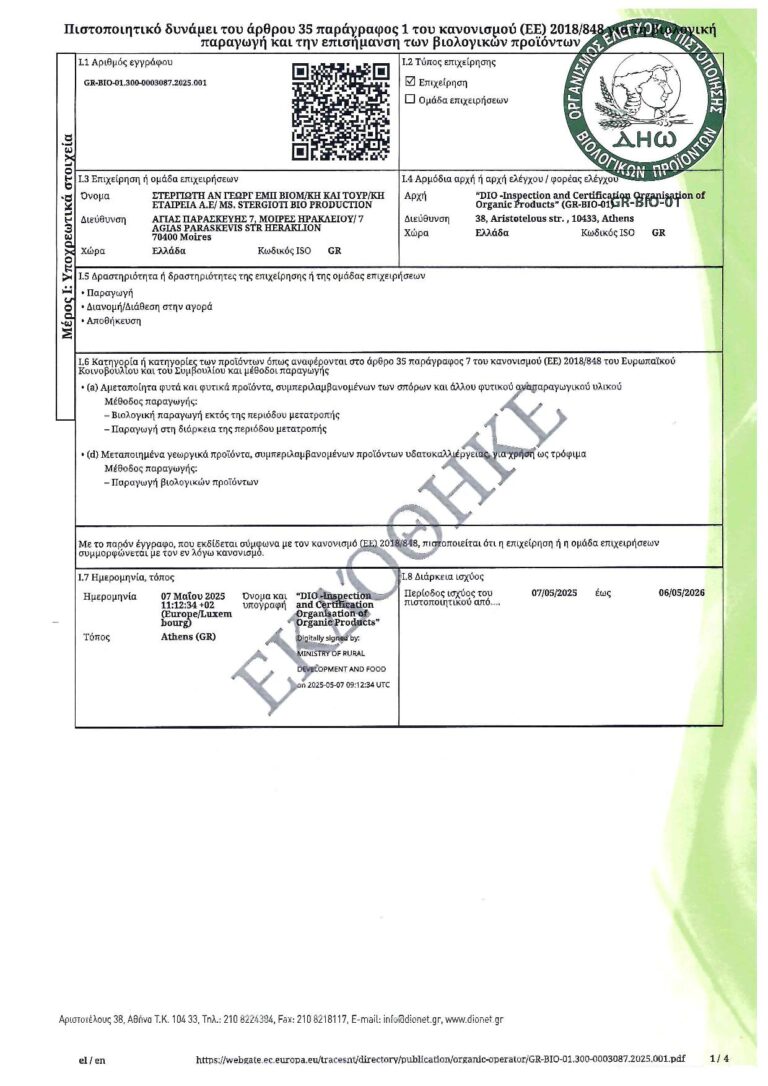
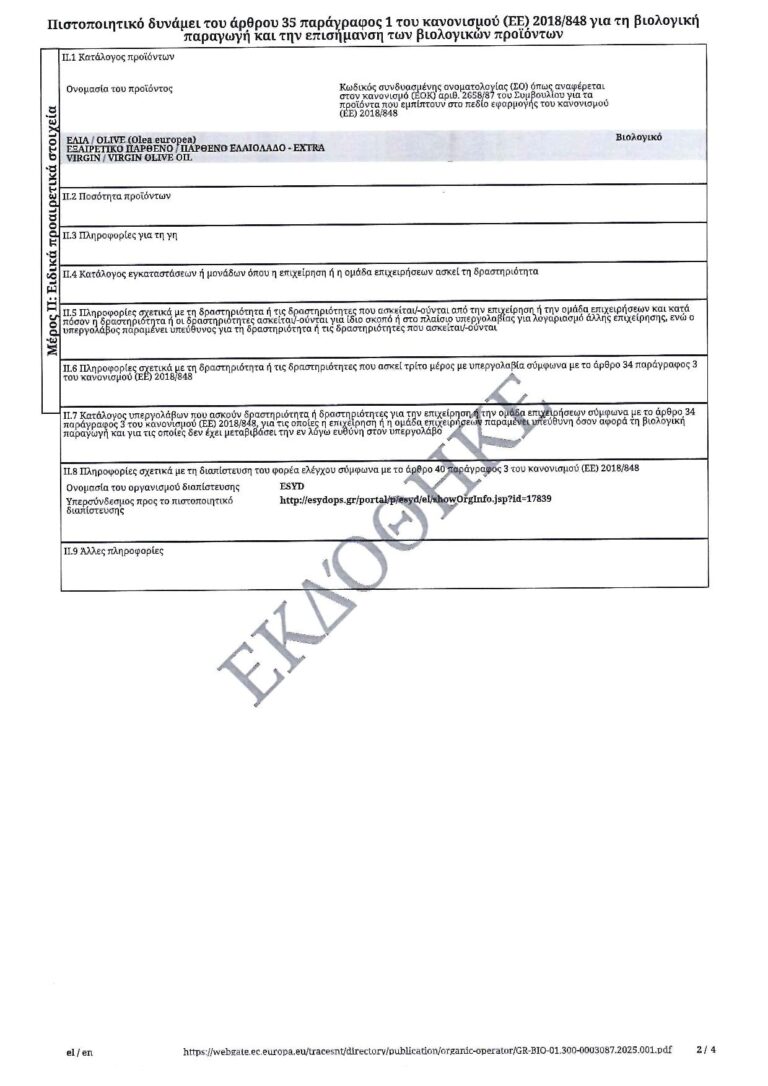
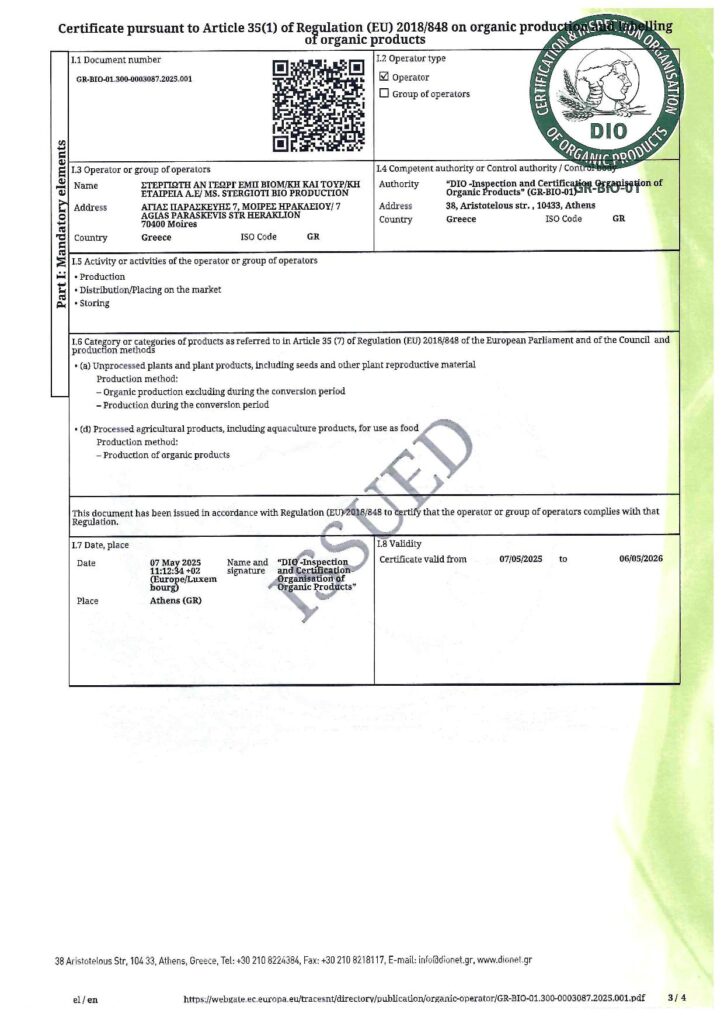
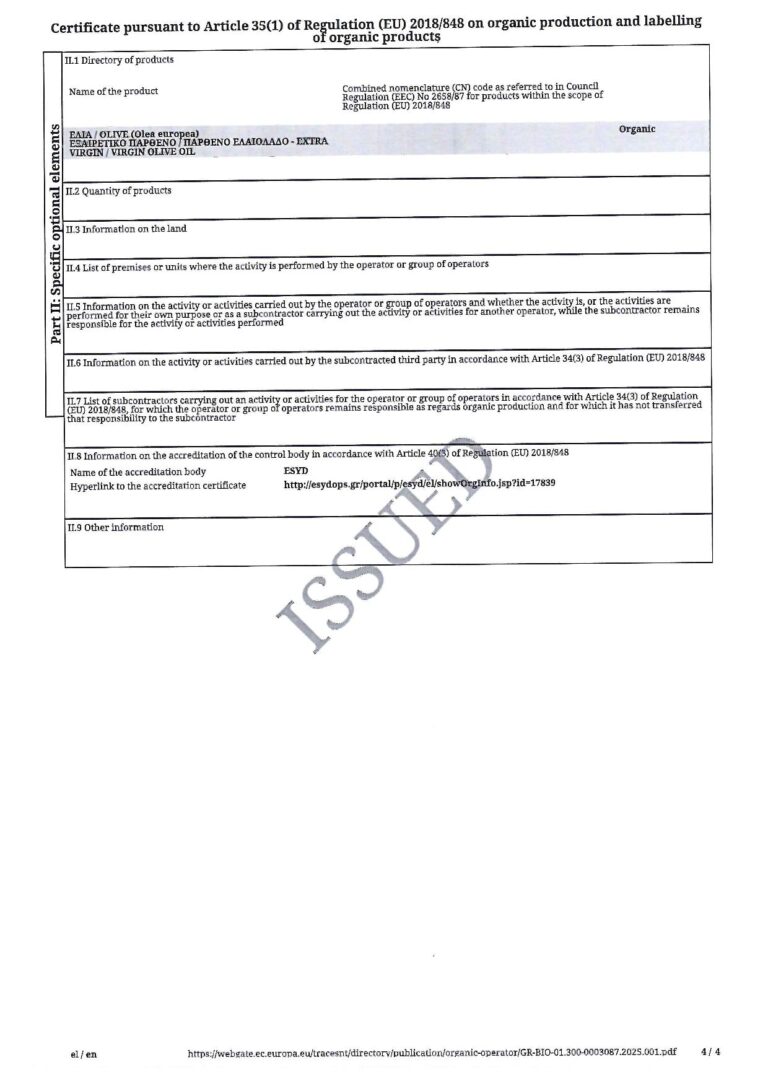
Certifications of Organic Farming
Our official organic farming certifications verify that production complies with strict international standards, including ELOT and European EN ISO 22000, ensuring no synthetic pesticides, fertilizers, GMOs, or harmful chemicals are used.
Olive Oil Chemical Analysis
Chemical analysis is part of our quality control and certification process, examining parameters such as free acidity, peroxide values, UV absorption index, fatty acid composition, and polyphenols. These ensure purity, freshness, flavor integrity, and consumer safety.