History The Land of Phaestus
The Soul of Minoan Crete and the Spirit of Olive Oil
Rising proudly above the fertile plain of Messara, Phaistos stands as one of the most radiant centers of Minoan civilization. From the Neolithic era to the golden age of the Minoans, it was a city of wealth, power, and culture. Here, palaces were built, myths were born, and one of the Mediterranean’s most brilliant civilizations flourished.
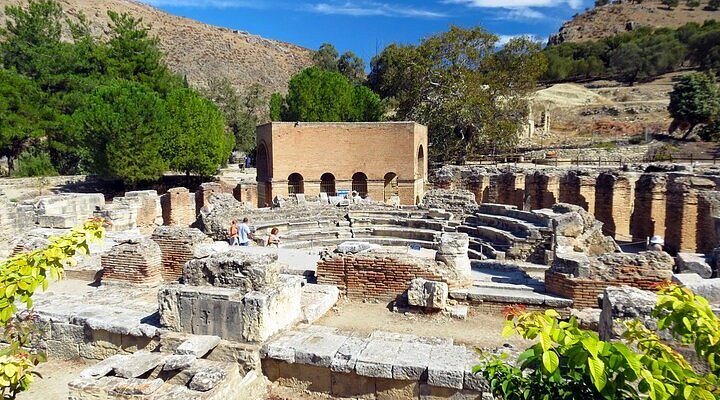
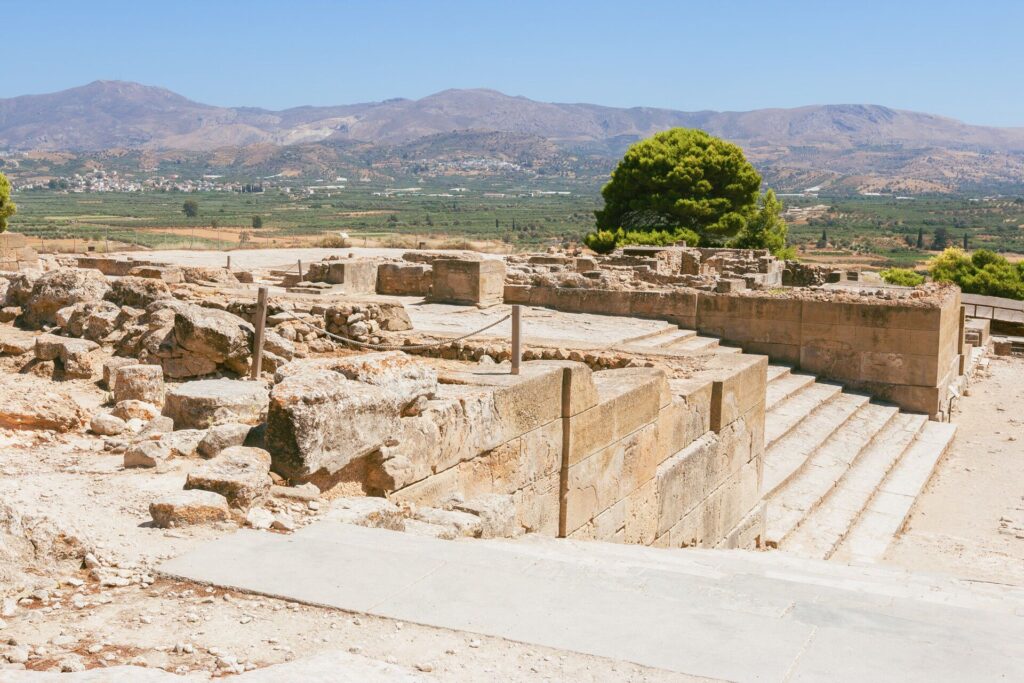
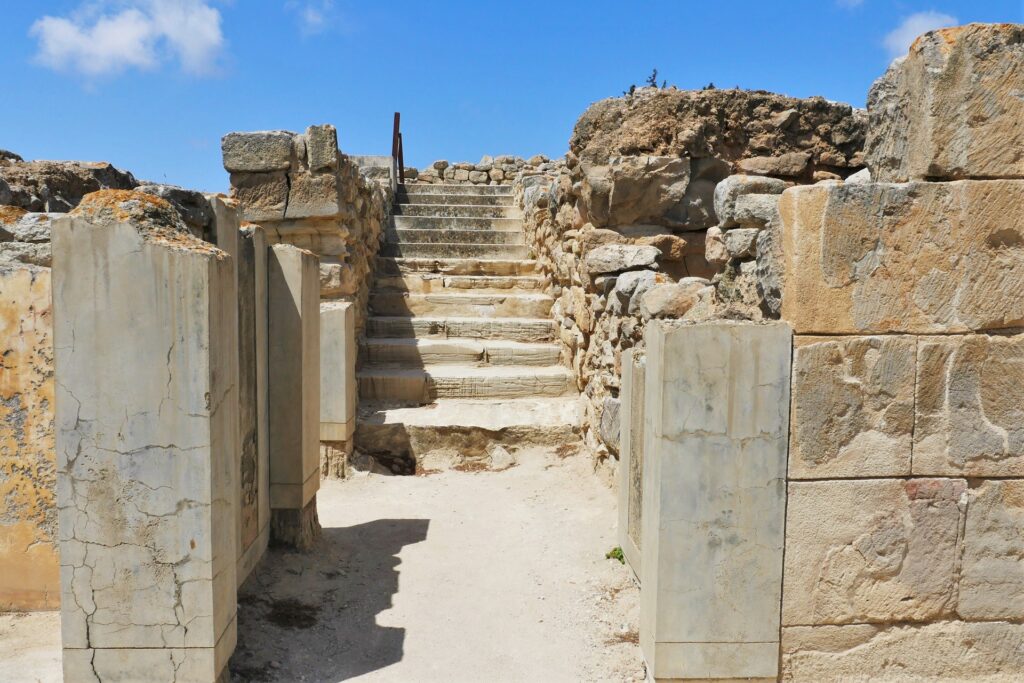
The Palace of Phaistos, second in size only to Knossos, served as an administrative and religious hub. Its elegant architecture—courtyards, staircases, storerooms, and ceremonial spaces—reflected the sophistication of Minoan society. Among its most mysterious treasures is the Phaistos Disc, a clay artifact inscribed with undeciphered symbols that continues to intrigue scholars and storytellers alike. Mythologically, the city is linked to Rhadamanthys, brother of King Minos, and is praised by Homer as a “well-built city,” affirming its timeless significance.
Within this eternal landscape, the olive trees of Phaistos have rooted deep into the earth since antiquity. The sacred tree of the Minoans offered its fruit for the production of olive oil—a gift that served as nourishment, light, medicine, and a symbol of sanctity. Today, just as in ancient times, the olive groves of the region continue to yield the precious oil of the Cretan land, connecting every traveler to a tradition that endures through centuries.
Phaistos is not merely an archaeological site—it is a living bond between past and present. It is the land that gives birth to our olive oil, Phaistos Olive Oil, crafted with the same purity, authenticity, and reverence that once defined the Minoan way of life. In every drop, we tell the story of Phaistos—a story of earth, memory, and culture.
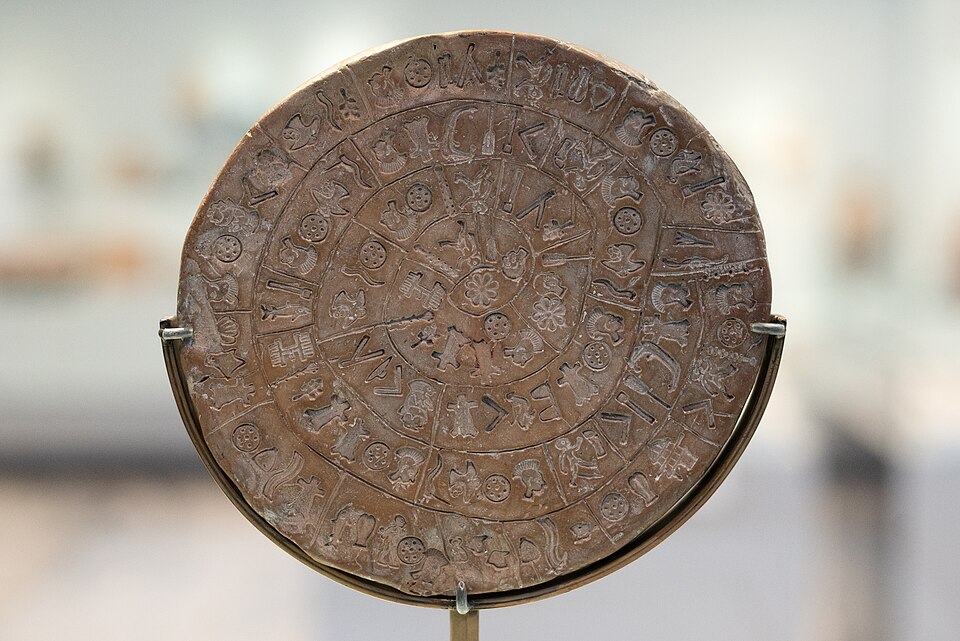
The Phaistos Disc – The Enigma of Minoan Crete As if it leapt from the pages of an ancient thriller, the Phaistos Disc remains one of the most mysterious artifacts of prehistory. Discovered in 1908 at the palace of Phaistos, it bears 241 symbols arranged in a spiral, resembling ideograms, animals, tools, and human figures.
Made of clay and fired to preserve it, the disc inspires awe not only for its craftsmanship but also for the unknown message it holds. Despite dozens of theories, no one has definitively deciphered its content. Is it a prayer? A hymn? A catalog? Or perhaps something we haven’t yet imagined?
The Phaistos Disc is not just an archaeological find. It’s a reminder that history still holds secrets waiting to be revealed.
Crete
Crete is the largest island of Greece and one of the most historically significant regions of the Mediterranean. Its cultural heritage stretches back thousands of years, beginning with the Minoan civilization, considered the earliest advanced society in Europe. The palaces of Knossos, Phaistos, and Malia stand as evidence of this remarkable period, while numerous archaeological sites across the island preserve traces of later Greek, Roman, Byzantine, Venetian, and Ottoman influences.
Cretan culture is deeply shaped by this long and diverse history. Architecture on the island reflects different periods of rule, from Venetian fortresses and elegant loggias to Byzantine monasteries and Ottoman mosques. Traditional music and dance remain a vital part of daily life, with instruments such as the lyra and the lute accompanying local celebrations and festivals. Folk songs, often passed down orally through generations, express themes of love, history, and identity.
Language and oral tradition also play a central role. The Cretan dialect, while based on standard Greek, preserves unique expressions and a distinctive rhythm, reflecting the island’s independent spirit. Poetry, particularly in the form of mantinades—short, improvised couplets—continues to be a vibrant element of social gatherings.
Equally important is the Cretan diet, renowned worldwide as part of the Mediterranean nutritional model. Centered on olive oil, grains, vegetables, and local cheeses, it is not only a culinary tradition but also an expression of the islanders’ connection with their land and environment.
Overall, the culture of Crete is a synthesis of ancient legacies and living traditions. It combines the memory of one of the world’s earliest civilizations with the resilience and creativity of its people, making the island a unique cultural landscape within Greece and the wider Mediterranean.